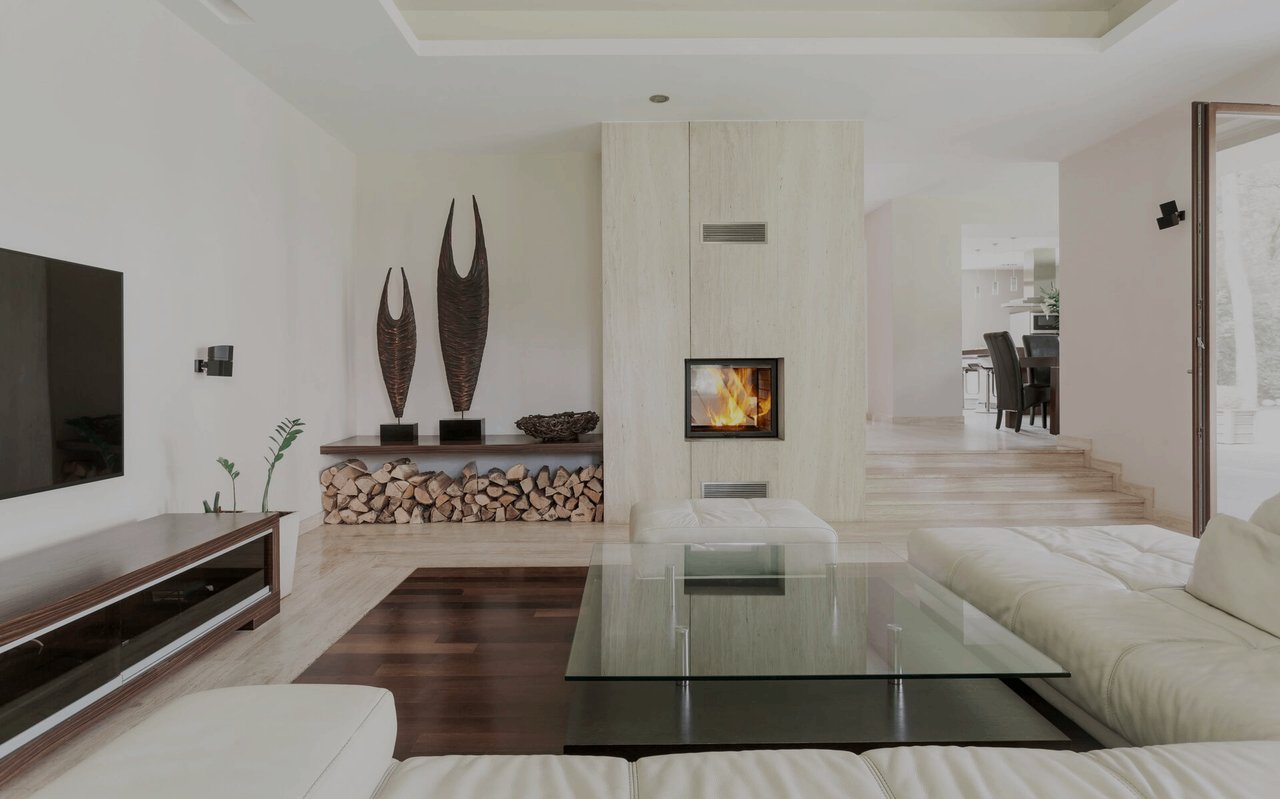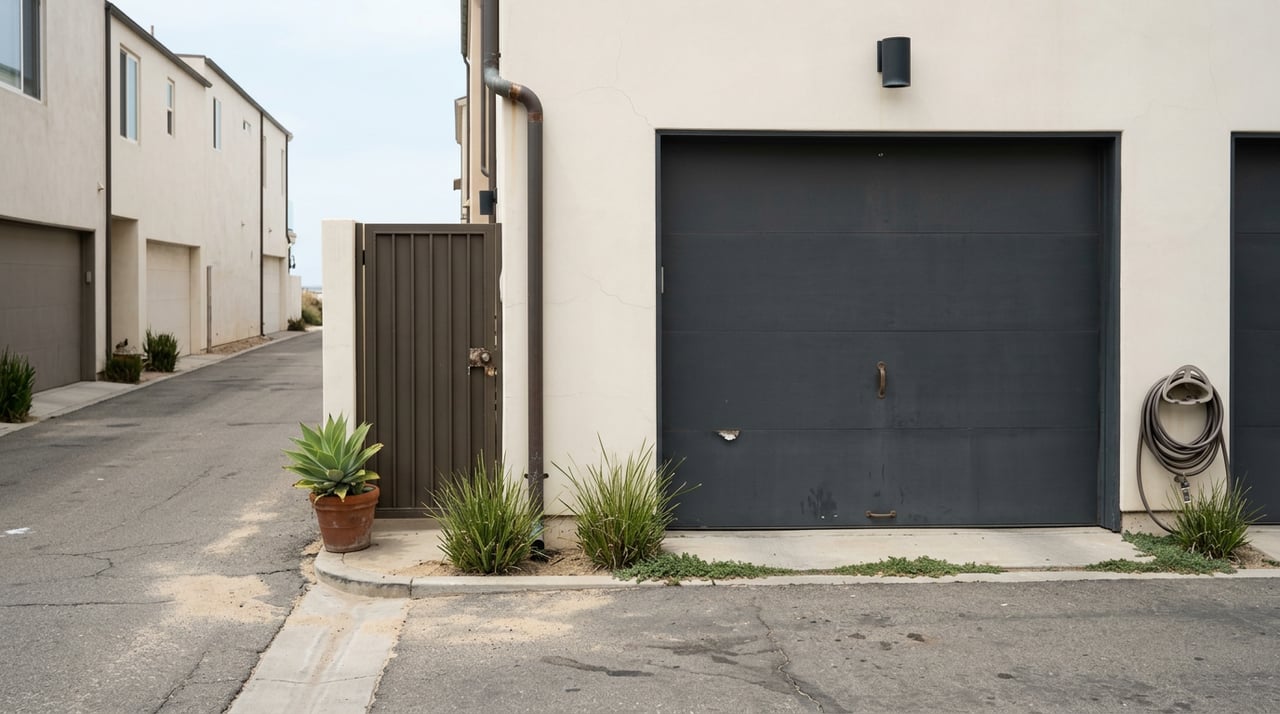
A buyer stands on a walk street in North Hermosa Beach on a June evening, six lots from the Strand, watching kids ride bikes down a paved lane with no cars in it. The agent mentions the price is roughly a million dollars less than the Strand home two blocks over. It sounds like a discount on the same lifestyle. It is not quite that, and the difference shows up months later, in a mailer from the city about a parking permit renewal.
Hermosa Beach's home prices break into three distinct bands, and most buyers learn this after they've already fallen for a specific block. As of May 2026, Strand properties trade at roughly $4 million to $12 million and up. Walk street homes run about $2.5 million to $4 million. Inland properties, mostly east of Pacific Coast Highway, land between $1.3 million and $2.2 million. The citywide median sale price sat near $1.99 million in March 2026, a number that only makes sense once you understand it's an average across three markets that behave nothing alike.
The gap between Strand and walk street pricing looks like a straightforward discount for giving up beachfront. It isn't. What you're actually buying at the walk street price point is a bet on how many off-street parking spaces your specific lot happens to have, because the city caps how much street parking you can lease no matter what you paid for the house.
What "Walk Street" Actually Means Here
Walk streets are a physical layout, not a marketing term. The house fronts a pedestrian-only lane, no cars, no curb, just a paved or landscaped walkway that functions as a shared yard for the block. Parking and garage access sit at the rear of the lot, reached from a regular street or alley behind the home. Lots tend to run about 30 feet of frontage, which is why front yards on these streets read as more generous than a typical Sand Section lot despite the density around them.
The appeal is real. No traffic noise, no cars rolling past a stroller, a block that functions like a shared common space rather than a thoroughfare. Hermosa's walk streets also tend to be flatter than Manhattan Beach's version of the same layout, which matters if you're pushing a bike or a wagon.
What the walk street layout does not include is guaranteed parking for a second car, a third driver in the household, or weekend guests. That's where the price tag and the ownership experience start to diverge.
The Permit That Doesn't Scale With the Price
Hermosa Beach runs a residential parking permit system inside a defined zone the city calls the impacted parking area. The boundary is specific: the Strand on the west, Loma Drive, Park Avenue, or Morningside Drive on the east, plus a stretch of Cypress Avenue between 11th Street and Pier Avenue. Nearly every walk street and Sand Section address falls inside this line.
Regardless of what you paid for the home, the city caps residential permits at three per residence. A permit costs $60 for the 2026-2027 cycle. One of the three can be designated a transferable guest permit instead of tied to a specific vehicle. A fourth permit is available only through an appeals process, and only if you submit a signed affidavit stating that the number of drivers in the household exceeds the number of available on-site parking spaces. If you want to legally park in your own driveway without blocking it, that's a separate one-time $328 driveway permit.
The city didn't set this cap arbitrarily. A few years back, an internal count found the city had issued nearly three times as many permits as there were physical parking spaces to hold them, a mismatch Mayor Justin Massey described publicly as the reason the program needed an overhaul. The system has kept tightening since. Stricter residency verification rules introduced in a prior cycle caused permit issuance to fall from 8,926 in 2022-23 to 5,901 in 2025-26, according to an Easy Reader News report on the October 2025 City Council meeting where members voted to relax those same rules after resident complaints. The council now accepts leases and utility bills as proof of residency again, a change aimed squarely at renters and new arrivals who'd been shut out of the permit system entirely.
None of this scales with home price. A $4 million walk street home with a two-car garage and no driveway apron faces the exact same three-permit ceiling as a $1.5 million inland property with a wide driveway. The premium you pay for walk street proximity buys the location and the pedestrian frontage. It does not buy you out of the city's parking math.
The Short-Term Rental Wrinkle
If part of the appeal of a walk street or Sand Section purchase is offsetting the mortgage with short-term rental income, verify the permit status before you write an offer. Hermosa Beach's short-term rental ordinance restricts STR permits primarily to commercially-zoned properties, and the city actively enforces violations. Only a small fraction of properties currently operating as short-term rentals hold valid permits. A listing agent's mention of "rental potential" is not the same as a transferable permit, and permits do not automatically carry over to a new owner. This is worth a direct question to the seller's agent and, ideally, a call to the city before removing contingencies.
The Greenbelt Alternative
Not every walkable Hermosa location carries the same parking constraint. Homes along the Hermosa Valley Greenbelt, the 3.7-mile landscaped trail running roughly parallel between Ardmore and Valley Drive, offer a different version of car-free living. The Greenbelt is used by joggers, dog walkers, and parents with strollers rather than functioning as a residential frontage, but many of the properties near it sit east of the tightest parking zone, in the Hermosa Valley section, where driveways and garages are more standard and the three-permit ceiling matters less because most owners aren't relying on street parking in the first place.
If the draw is walkability without the density of the Sand Section, a Greenbelt-adjacent property in Hermosa Valley is worth cross-shopping against a walk street listing before assuming the walk street premium is the only way to get it.
How to Actually Use This Comparison
Before comparing a walk street listing to a Sand Section or inland alternative on price alone, ask three questions that the listing photos won't answer:
How many off-street parking spaces does the specific lot have, and are they garage spaces or open driveway spaces subject to the separate driveway permit fee? A two-car garage with no driveway apron is a different ownership experience than a two-car driveway you also have to leave the sedan on the street some nights.
How many licensed drivers will actually live in the home, and does that number exceed three? If it does, you're not automatically covered. You'll need the affidavit process, and approval isn't guaranteed on the timeline you want.
If rental income factors into the purchase decision, has the seller's agent confirmed the property's zoning and any existing STR permit status directly with the city, rather than describing rental potential in general terms?
None of these questions show up in a comps sheet. They're the kind of local detail that separates a walk street purchase that feels like a discount from one that comes with a parking headache nobody mentioned during the tour.
Frequently Asked Questions
Does the parking permit cap apply to Strand properties too? Yes. The impacted parking area runs along the Strand itself on the west boundary, so most Strand addresses face the same three-permit structure as walk street and Sand Section homes.
Can I buy my way out of the three-permit limit? Not directly. The only path to a fourth permit is the affidavit process demonstrating your household has more drivers than on-site parking. There's no paid upgrade tier.
Is the driveway permit the same as a residential parking permit? No. The $328 driveway permit is a separate, one-time fee that allows you to legally park in front of your own driveway without blocking it. It doesn't add to your three-permit residential allotment.
If you're weighing a walk street address against a Sand Section, Hill Section, or Greenbelt-adjacent property and want to know what a specific lot's parking situation actually looks like before you tour it, reach out to Colin Aita for a private, no-pressure consultation.