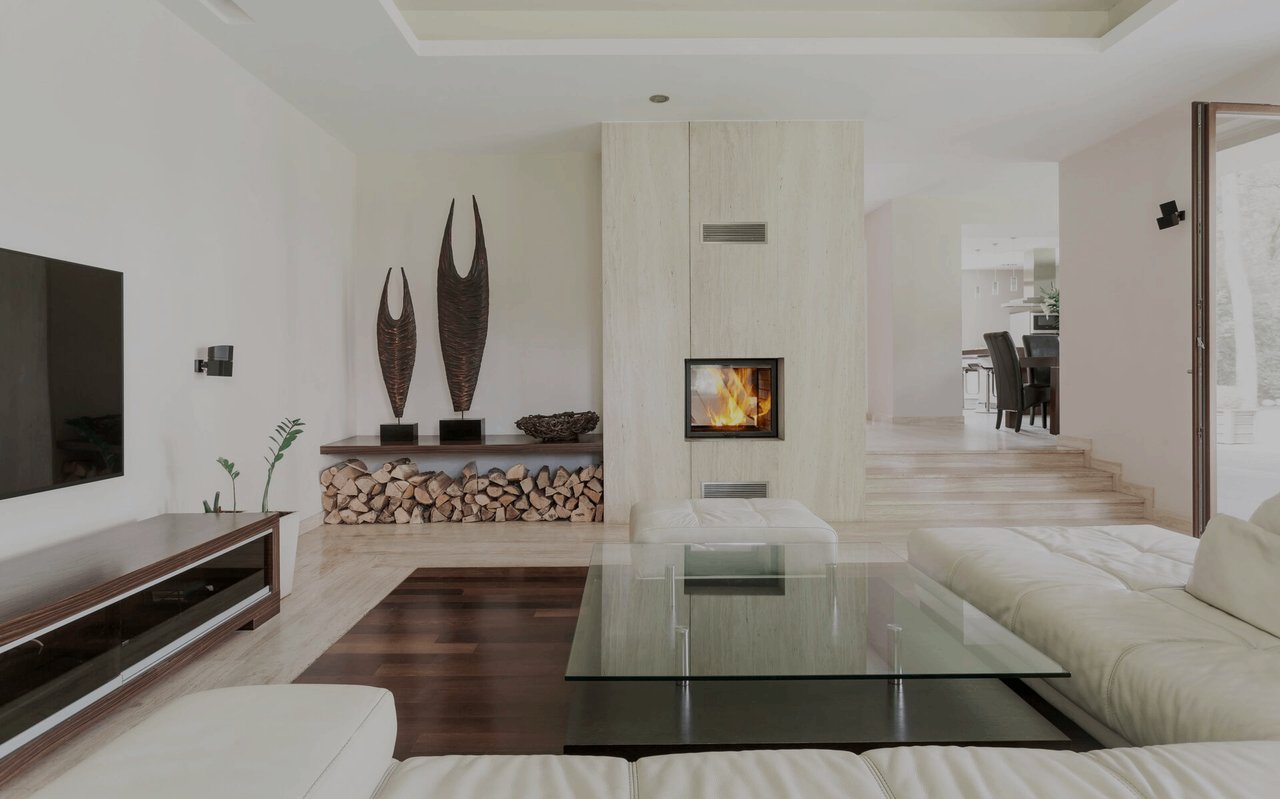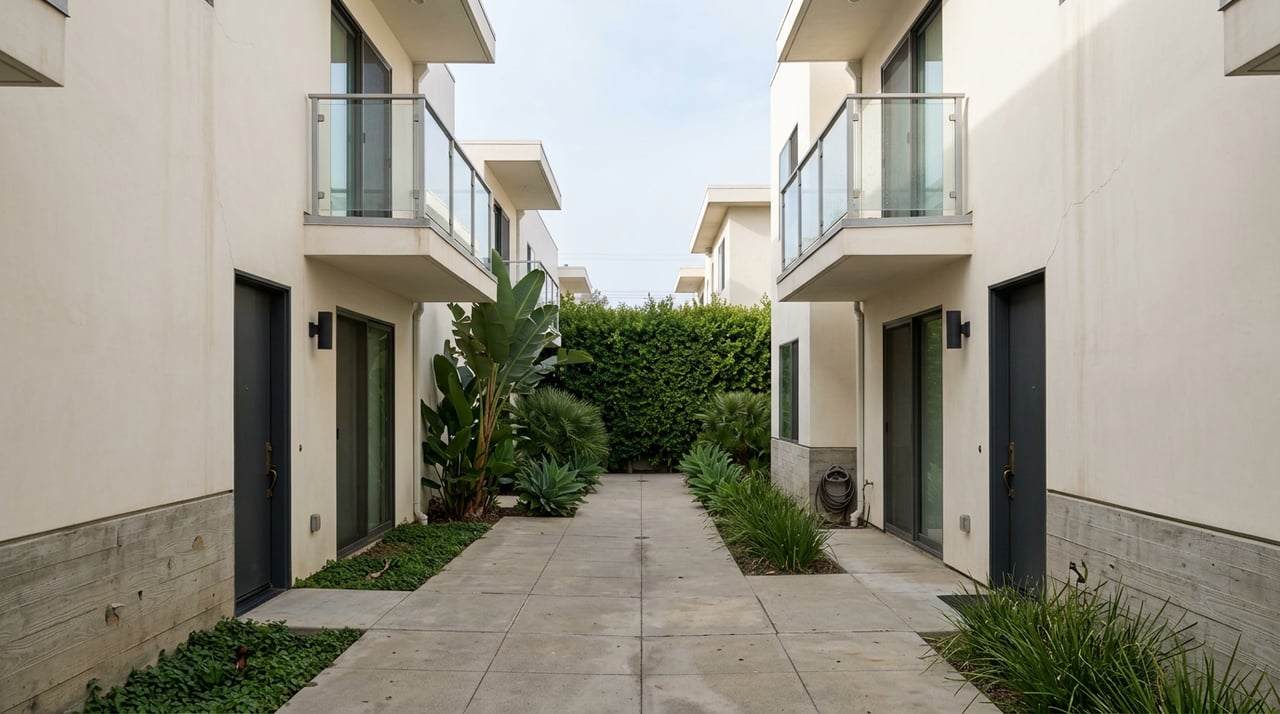
A buyer touring Playa Vista this summer pulls up two listings side by side on their phone. Same square footage, same finishes, same $950,000 price tag, two blocks apart. On paper, it is a coin flip. Then the loan officer runs the numbers and one unit's monthly payment comes in several hundred dollars higher than the other, before a single upgrade or negotiation enters the picture.
That gap is not a pricing mistake. It is Playa Vista's Phase 1 and Phase 2 split showing up exactly where most buyers never think to look: the tax bill and the HOA ledger, not the listing photo.
Same Price, Different Math
Playa Vista was built in two distinct waves. Phase 1 covers the original condo buildings that went up between roughly 2003 and 2011. Phase 2 followed later, filling in the newer blocks closer to Runway's shops and restaurants. The two phases look similar from the sidewalk. Financially, they are structured in almost opposite ways, and that structure is baked into every monthly statement an owner receives for as long as they hold the property.
Here is the side-by-side that most portal listings never surface:
| Cost line | Phase 1 | Phase 2 |
|---|---|---|
| PVPAL master HOA | Roughly $375 a month | Roughly $375 a month |
| Building-level HOA | Typically $250 to $950 a month, building-dependent | Typically $75 to $1,000 or more a month, building-dependent |
| Mello-Roos special tax | Yes, layered on top of the standard property tax bill until the bond matures | None |
| How infrastructure got paid for | Financed with a public bond, repaid annually through the tax bill | Paid upfront by the developer and folded into the original purchase price |
The master HOA line is identical because every Playa Vista owner, regardless of phase, pays into PVPAL, the Playa Vista Parks and Landscape Corporation, for access to the shared amenity package: The CenterPointe Club, The Resort, the community pools, and the parks that thread through the neighborhood. That part of the bill is not where the divergence lives. The divergence lives one line down.
Why One Phase Has a Tax the Other Doesn't
Mello-Roos is not a Playa Vista invention. It is a financing tool that goes back to California's Community Facilities Act of 1982, and it works the same way in every district that uses it: a public agency forms a Community Facilities District, issues bonds to pay for streets, parks, utilities and similar infrastructure, then repays those bonds through an annual special tax on the parcels inside the district.
Playa Vista's Phase 1 buildings sit inside that district. Phase 2 does not, because by the time that section was built, the developer covered those same infrastructure costs directly and priced them into the homes from day one. Neither approach is better in the abstract. They are just two different ways to pay for the same roads and parks, one collected annually for decades, the other collected once at the closing table in the form of a higher base price.
The exact levy on a Phase 1 unit depends on its square footage and the CFD's current rate schedule, and local buyer guides consistently put the practical monthly bite somewhere between $100 and $500, though the only number that matters for a specific unit is the one printed on that parcel's Los Angeles County secured property tax bill. What is more predictable is the ceiling: California law caps Mello-Roos escalation at 2 percent a year, and the bond behind Playa Vista's Phase 1 assessment is expected to mature around 2031. After that, the line item disappears from the bill entirely. Buyers closing in 2026 are, in effect, pricing in roughly five more years of that tax before it rolls off.
The Two HOAs You're Actually Paying
Ask most first-time Playa Vista buyers how many HOA bills they expect and the answer is one. The real number is two, and it catches people off guard often enough that it is worth spelling out plainly.
Every owner pays PVPAL, the master association, at roughly $375 a month. That fee covers the shared lifestyle infrastructure: cable, internet, fitness access at both The CenterPointe Club and The Resort, pool access, and the upkeep of the neighborhood's parks. On top of that sits a separate building-level HOA, set by whichever association governs the specific condo or townhome, and that number swings widely depending on the building's age, unit count, and amenity list. A smaller building with fewer shared systems might land near $250 a month. A newer building with an elevator, on-site gym, and lower unit count can push past $900 or even $1,000.
Stack the two together and a buyer's true monthly association cost, before Mello-Roos ever enters the conversation, typically runs somewhere in the $625 to $1,375 range. That is before the mortgage payment, before regular property tax, before insurance. It is also before the one fee that shows up nowhere on the listing sheet at all.
Picture two 1,200-square-foot Playa Vista condos, both listed at $950,000 this month. The Phase 1 unit's county tax bill carries a Mello-Roos line worth roughly $100 to $500 a month on top of the standard 1.1 to 1.2 percent base property tax rate. The Phase 2 unit two blocks over has no such line, because its share of the same parks and streets was already paid for in the original sale price back when the building went up. Same sticker price. Different bill, every month, until that Phase 1 bond retires.
The Fee That Shows Up at the Closing Table
There is one more cost that neither the listing photo nor the monthly HOA statement will ever show, because it only appears once, at resale. Whenever a Playa Vista property sells, 0.75 percent of the sale price goes to Playa Vista Community Services, a fund that pays for community programming like park concerts and outdoor movie nights, plus ongoing preservation work for the Ballona Wetlands that border the neighborhood. On a $1 million sale, that is a $7,500 charge that shows up in escrow, not on the MLS sheet.
Custom and local practice usually puts this fee on the seller's side of the ledger, but it is a negotiated point, not a fixed rule. In a market where buyers have leverage, it can become a bargaining chip. In a market where sellers hold the leverage, it tends to stay put as the seller's cost of doing business in a master-planned community with amenities most Los Angeles neighborhoods simply do not have.
What a Slower 2026 Market Means for This Math
None of this math exists in a vacuum. It matters more right now because Playa Vista's market has cooled from its 2024 highs. MLS data pulled across the March through June 2026 window puts the median sold price for the neighborhood's combined single-family and condo sales at roughly $1.37 million, with plenty of individual condos still transacting in the $850,000 to $1.2 million range depending on size and building. Listings that were routinely going under contract in about 61 days a year earlier were taking closer to 79 days to find a buyer in early 2026.
That slower pace changes how the Phase 1 versus Phase 2 math should be used at the negotiating table. A slower market gives buyers more room to ask a seller to account for a heavy carrying-cost stack, whether that stack is a Mello-Roos line, an above-average building HOA, or both. A Phase 1 seller whose unit carries a meaningful special tax is competing against Phase 2 comparables that do not carry that same monthly drag, and in a market where days on market have stretched, that comparison shows up in offers, not just in conversation.
How to Actually Use This Comparison
The practical move is simple even though the underlying structure is not: before comparing two Playa Vista units on price alone, pull the current Los Angeles County secured property tax bill for each parcel to see whether a Mello-Roos line exists and what it costs today, confirm the building-level HOA budget directly with that building's association rather than relying on a listing sheet summary, and ask early in any transaction how the 0.75 percent Community Enhancement Fee is being allocated between buyer and seller. Those three data points, not the list price, are what actually separate two units that look identical on a portal.
Frequently Asked Questions
Does every Phase 1 unit have the same Mello-Roos amount? No. The levy is based on square footage and the specific CFD formula, so two units in different Phase 1 buildings can carry different amounts. The parcel's current county tax bill is the only reliable source for an exact figure.
Is a Phase 2 unit automatically the better financial choice? Not necessarily. Phase 2 units avoid Mello-Roos, but their building-level HOA can run as high as or higher than a comparable Phase 1 building, and the original purchase price already reflects the infrastructure cost that Phase 1 spreads out over time. The comparison has to be run unit by unit.
Is the Community Enhancement Fee something a buyer can negotiate away? It is a negotiated point rather than a fixed cost. Custom typically has the seller pay it, but in a market where buyers have more leverage, it is reasonable to raise it as part of the broader offer conversation.
Comparing two Playa Vista listings takes more than a glance at the price per square foot. It takes pulling the actual tax bill, the actual HOA budget, and understanding which financing era a building was built in. Colin Aita works Playa Vista alongside the rest of the South Bay and select Westside enclaves, and can walk you through exactly what a specific unit's real monthly number looks like before you write an offer. Contact Colin for a private, no-pressure consultation.